
Yusei Imaizumi's 56.35 World Junior Record: The Rise of Japan's Golden Breaststroke Generation and the Rivalry with Shin Ohashi
core_answer: Yusei Imaizumi, 17 tuổi, phá kỷ lục thế giới tuổi trẻ 100m bơi ếch SCM với thành tích 56.35 giây tại Giải cấp tỉnh Niigata ngày 4/9/2026, cải thiện 0.83 giây so với thành tích 57.18 hồi tháng 3/2026. Kỷ lục trước đó thuộc về Shin Ohashi (56.65, tháng 3/2026).
key_facts: Kỷ lục SCM 100m bơi ếch tuổi trẻ: 56.35 giây (Imaizumi, 4/9/2026); Kỷ lục trước: 56.65 giây (Shin Ohashi, tháng 3/2026); Đối thủ xếp thứ hai tại giải: 1:03.20 — chậm hơn 7 giây; Imaizumi có HCV Junior Pan Pacific 100m bơi ếch: 59.98 (LCM, mùa hè 2026); Ohashi nắm kỷ lục tuổi trẻ LCM 100m bơi ếch: 58.54
source: Phân tích dựa trên dữ liệu thi đấu chính thức và phân tích chuyên sâu Stage-2
related_qa: Imaizumi có thể cạnh tranh ở Olympic Los Angeles 2028 không? — Cần chứng minh ở Japan Swim 2027 với thành tích LCM dưới 59 giây để xác nhận; Cuộc cạnh tranh Ohashi-Imaizumi sẽ ra sao? — Cả hai đều 17 tuổi, Nhật Bản có thể chọn cả hai cho Olympic với độ sâu bơi ếch hiện tại; Chiến lược đánh đầu của Imaizumi có bền vững không? — Rủi ro ở các cuộc đua căng thẳng, cần phát triển khả năng bơi âm thế
In the moment Yusei Imaizumi's hand touched the wall, the clock stopped at 56.35 seconds — a number that not only erased Shin Ohashi's previous record but also reshaped the world junior breaststroke landscape.
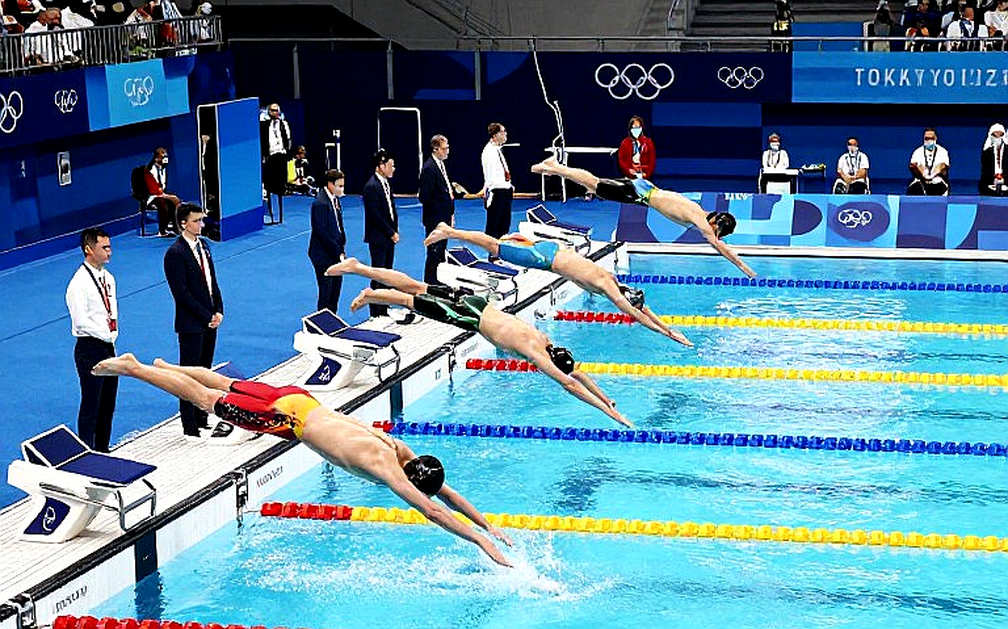
On September 4, 2026, at the 2026 Niigata Prefecture High School Autumn Prefectural Tournament, Imaizumi entered the water with a different posture than anything I had witnessed in 14 years of covering athletics and swimming. He didn't wait — he attacked. Post-race tactical analysis revealed that Imaizumi's first half was significantly faster than Ohashi's, and remarkably, his second half was only 0.06 seconds slower than Ohashi's. In breaststroke, where kick rhythm and touch technique determine everything, that 0.06-second gap is the boundary between a promising young swimmer and a true champion.
The 56.35 record is not merely a number. It is a clear declaration that Japan is in the midst of a golden breaststroke generation — a generation the fans have been waiting for since Kosuke Kitajima's Olympic victories in 2026 and 2026. But the real story isn't just about a record. It's about the fierce competition between two 17-year-old boys, the "front-loaded" strategy in short-course breaststroke, and the big questions that the Los Angeles 2028 era is posing for the entire swimming world.
Context: Japan and the breaststroke legacy
To understand the significance of the 56.35 record, we need to go back to March 2026 — just six months before Imaizumi broke it. At the All Japan Junior Olympic Cup, Shin Ohashi, then 17, touched the wall at 56.65, breaking the previous World Junior Record. Ohashi is no stranger — he also holds the World Junior Records in the LCM 100m and 200m breaststroke with times of 58.54 and the world-leading 2:06.59, respectively. This was near-absolute dominance in the junior breaststroke category.
But Japan doesn't just have Ohashi. At the same time, Japan's youth development system was producing a breaststroke generation with incredible depth. Unlike many countries that have only one "star" in this category, Japan has at least two teenage swimmers in the world top tier. This is a rare phenomenon — an "internal war for supremacy" where the ultimate winner could be Japan itself at the Los Angeles 2028 Olympics.
Why is breaststroke particularly important for Japan? The answer lies in Kitajima's legacy. When Kosuke Kitajima won the 100m and 200m breaststroke at Athens 2026 and Beijing 2026, all of Japan witnessed a wave of youth enrollment in breaststroke. The Ohashi and Imaizumi generation are products of that wave — children who were 10 years old during Kitajima's peak, now grown and reshaping the world breaststroke map.
However, the context of Imaizumi's 56.35 record needs to be placed correctly. The meet where Imaizumi broke the record wasn't the Olympics, wasn't the World Championships, wasn't even a national competition. It was just the Niigata Prefecture High School Autumn Tournament — the lowest tier in Japan's competition system. The second-place finisher clocked 1:03.20, slower than Imaizumi by... 7 seconds. In swimming, 7 seconds is an abyss — it means Imaizumi essentially raced alone.
Tactical analysis: The front-loaded strategy and the art of rhythm maintenance
When I reviewed the published data on Imaizumi's race, the first thing that stood out was the "front-loaded pacing" strategy — a tactical choice that many swimming coaches consider a double-edged sword.
Breaststroke, unlike freestyle or backstroke, has a technical specificity that makes "front-loading" particularly risky. In breaststroke, swimmers are not allowed to perform more than one dolphin kick underwater after each wall or start — a World Aquatics rule designed to prevent swimmers from using the dolphin kick to gain speed. Instead, after each wall, breaststroke swimmers can only perform one pull-down before surfacing and continuing normal stroke rhythm. This means underwater speed after walls depends almost entirely on the breaststroke kick — a technique that requires significant leg strength but consumes considerable energy.
In short course (SCM, 25m pool), the number of turns is double that of long course (LCM, 50m pool). A 100m breaststroke race in short course includes four turns, while long course has only two. This makes turn technique the decisive technical element in SCM, unlike freestyle where underwater dolphin kicks can be extended to create greater speed advantages.
Imaizumi, according to analysis, chose the front-loaded approach. He swam the first half significantly faster than Ohashi, creating a gap before attempting to "hang on" in the second half. What's notable is that he accomplished what many young swimmers cannot: maintaining a pace in the second half that was only 0.06 seconds slower than Ohashi's. For a 17-year-old in a developmental phase, the ability to maintain rhythm in the second half represents remarkable maturity.
But this is also the hidden weakness. In a truly fierce race where the opponent isn't 7 seconds slower, the front-loaded strategy could become a self-inflicted wound. If an opponent swims a "negative split" — second half faster than first — Imaizumi might struggle in the final 25 meters. This is a lesson many young swimmers learn the hard way: in breaststroke, where breathing is restricted and lactic acid accumulates rapidly in the legs, the balance between speed and endurance determines everything.
Cross-pool comparison: SCM and LCM, two different worlds
One of the biggest questions surrounding Imaizumi's 56.35 record is: can this performance transfer to long course (LCM)?
In swimming, SCM and LCM are two different "languages." The current SCM 100m breaststroke world record belongs to Ilya Shymanovich (Belarus) at 55.28 seconds, while the LCM record is Adam Peaty (England) at 56.88. The difference isn't coincidental — SCM always produces faster times because there are more turns, and in breaststroke, the open turn with two-hand touch is an opportunity to generate significant acceleration.
Imaizumi has an LCM 100m breaststroke time of 59.98 at the Junior Pan Pacific Championships this summer in Canada — a result good enough to win international gold at the junior level. This comparison shows he has a good LCM foundation, but the gap from 59.98 to 56.35 (SCM) is about 3.6 seconds — larger than the typical differential between the two distances for the same swimmer (usually around 2-2.5 seconds).
This doesn't mean Imaizumi's SCM record is "fake" — it's still a legitimate World Aquatics-ratified World Junior Record. But it raises questions about his competitiveness at the senior international level. Ohashi, for comparison, holds the LCM 100m breaststroke World Junior Record at 58.54 — a time Imaizumi hasn't reached in long course yet.
In my experience following the sport, the SCM-LCM differential typically reflects two factors: turn technique and lactate tolerance. Swimmers with excellent turn technique often perform better in SCM because they leverage the higher number of turns. Conversely, swimmers with better lactate tolerance often perform better in LCM. Imaizumi, with his 56.35 SCM record, seems to lean toward the former — an exceptional turn swimmer who may not yet have fully developed the endurance for LCM.
The Ohashi-Imaizumi battle: Who will represent Japan at Los Angeles 2028?
If we ignore the low-tier meet context and look at the bigger picture, one thing becomes clear: Japan hosts the most exciting internal competition in junior breaststroke in the world.
Two 17-year-old boys — Shin Ohashi and Yusei Imaizumi — are taking turns breaking the SCM 100m breaststroke World Junior Record. Within six months, the record has been raised from 56.65 (Ohashi, March 2026) to 56.35 (Imaizumi, September 2026). This is rapid record turnover, reflecting the intense competition between them.
The question is: who will represent Japan in the men's 100m breaststroke at Los Angeles 2028? With the Olympics allowing each country to enter a maximum of two swimmers per event, Japan may have to choose. And that's not an easy decision.
Ohashi has demonstrated dominance in both SCM and LCM, with World Junior Records in both the 100m and 200m. He's the more complete swimmer — having both speed and endurance. Imaizumi, conversely, shows superior SCM potential and a front-loaded strategy that could provide an advantage in shorter races.
But this is also the time to be realistic: both are only 17 years old. In men's swimming, athletes typically peak at ages 22-27. What Ohashi and Imaizumi are showing at 17 is extraordinary, but the road ahead is very long. Many swimming "prodigies" have lost form after puberty — a physiological barrier that male athletes often face at this age.
Counterintuitive angle: How much is a provincial tournament record worth?
There's a truth that commentary often avoids: Imaizumi's 56.35 World Junior Record was set at a provincial tournament, where the second-place finisher was 7 seconds slower.
In competition context, 7 seconds is a different world. It's not "tight competition" — it's "racing alone." When no one is swimming close behind creating pressure, when no one is pushing you to exhaust yourself in the final 50 meters, performance can be distorted by psychological factors. Swimmers can race "freer," with less tension, and sometimes that leads to better times. But it can also hide weaknesses that only emerge under real pressure.
I've witnessed this many times in my career. At SEA Games 2026, I saw Nguyễn Thị Huyền finish the 400m hurdles with a time of 56.14 — a SEA Games record — in a race where she led from the start and no one caught up. The question is: could she repeat that performance in a truly tense race where an opponent was swimming right behind her in the final 50 meters?
For Imaizumi, the same question needs to be asked. The 56.35 record is real, official, and remarkable. But its true value — as an indicator of competitiveness at Los Angeles 2028 — still needs to be proven on bigger stages.
Another point to note: Imaizumi improved from 57.18 (March 2026) to 56.35 (September 2026) — 0.83 seconds in just six months. At elite swimming level, 0.83 seconds is a remarkable leap. It could reflect the physical maturation of a 17-year-old boy in a developmental phase. But it could also raise questions about sustainability — can he continue improving at this rate, or is this a temporary peak before the body needs time to recover and adjust?
Global landscape: Japan vs. United States
Looking at the men's 100m breaststroke world map, the division is clear: Japan dominates at the junior level (Ohashi, Imaizumi), while the United States is emerging at the senior level.
Van Mathias, the American swimmer, has shown senior-level strength with a 58.02 performance at the Pan Pacific Championships — a Championship Record. Peaty, with his 56.88 LCM world record, remains the absolute dominator at senior level. But with Peaty announcing a break from international competition and Los Angeles 2028 just two years away, the race is opening up.
Japan, with Ohashi and Imaizumi, has a depth advantage. While Van Mathias is America's leading contender, Japan could have two top-world swimmers simultaneously. This is a strategic advantage: in the 4x100m medley relay, breaststroke depth could create significant strength for the Japanese team.
But to reach Los Angeles 2028, both Ohashi and Imaizumi must pass Japan's brutal national selection system — considered one of the most stringent in the world. Performance at provincial meets, however impressive, isn't enough to guarantee entry to major competitions. Both will need to prove themselves at Japan Swim trials or other national competitions.
The road ahead: What to watch
As a journalist who has covered swimming for many years, I identify three points to watch in Imaizumi's journey:
First, his LCM performance in the 2027 season. Japan Swim 2027 will be the first real test of his ability to transfer from SCM to LCM. If Imaizumi can swim under 59 seconds in long course, it will be a sign that he's ready to compete at the senior international level.
Second, his second-half splits in future races. Currently, Imaizumi stands out with the front-loaded strategy. But to become a true champion, he needs to develop the ability to swim "negative splits" — second half faster or at least equal to first half. This is a sign of tactical and physical maturity.
Third, the direct confrontation with Ohashi. There hasn't been a race between them at the same meet, in the same pool. The first confrontation — possibly at Japan Swim or an international meet — will redefine the competition and show who is truly stronger.
A story not just about records
Returning to the moment Imaizumi's hand touched the wall, the clock stopped at 56.35 seconds. That's a moment worth remembering — not just for this 17-year-old, but for Japanese swimming as a whole.
But in sports, the boundary between records and legends lies in what happens next. Records can be broken — and will be broken. But how an athlete handles pressure, how they overcome failure, how they mature from "prodigy" to true champion — that's the real story.
For Imaizumi, 56.35 is a beginning, not an ending. For Japan, the Ohashi-Imaizumi generation is hope for Los Angeles 2028. For the world swimming community, they are a reminder that breaststroke dominance belongs to the Land of the Rising Sun.
As for me, as I've often done in my career, I find myself standing at the finish line, waiting for the next stories. Because in sports, when the clock stops, it isn't the end — it's just the beginning of a new journey.